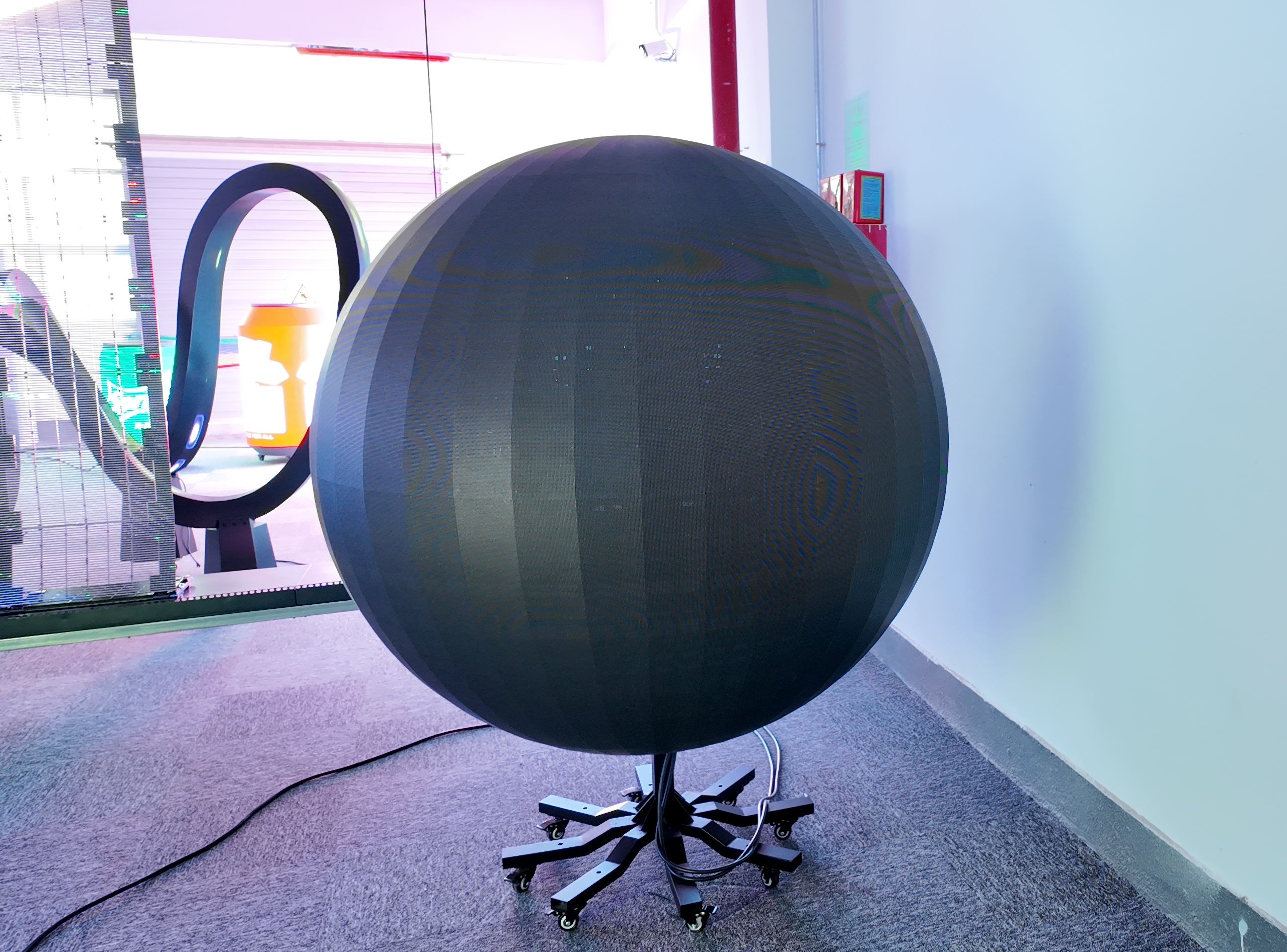
A spherical LED display (or spherical display) is a new type of LED display that breaks the limits of traditional flat screens. It uses a full sphere or hemisphere as its display surface, featuring 360° panoramic viewing, strong immersion and impressive visual impact.
1. Core Principle & Structure
Hardware Components
- Spherical frame: Made of lightweight alloy or carbon fiber, supporting the screen and ensuring spherical accuracy.
- LED display modules: Custom rigid or flexible modules assembled to fit the spherical curvature.
- Control system: Special video processor for spherical geometry mapping, color calibration and synchronous playback.
Imaging Method
LED lamps are evenly arranged on the spherical surface, with each lamp as an independent pixel.
The control system calculates and drives LEDs in real time to form a
continuous, undistorted image on the 3D curved surface.
Main Structure Types
- Watermelon-slice (fan-shaped) spherical display: Early design with blind spots at the north and south poles.
- Triangle (football-style) spherical display: Full-screen display but large pixel pitch (≥8.5mm).
- Six-sided panoramic spherical display: Current mainstream type, modular assembly, small pixel pitch and excellent display effect.
2. Main Classification
- By completeness: Full spherical display (360°), hemispherical display (180°).
- By environment: Indoor display (high-definition), outdoor display (waterproof, sun-proof, high brightness).
- By pixel pitch: Regular pitch (long-distance viewing), small pitch (P2–P4, close-range high-definition).
3. Core Advantages
- Full viewing angle: Clear and complete image from any angle.
- Extreme immersion: 360° visual wrapping, with audience retention over 40% higher than traditional screens.
- High-tech appearance: Strong artistic and futuristic sense, ideal for creative display.
- Wide content compatibility: Supports videos, 3D animations, data visualization and real-time interactive content.
4. Typical Applications
- Commercial centers & landmarks: Giant spherical advertising devices to attract crowds and create visual landmarks.
- Science & technology museums: 3D popular science displays of planets, earth structure, weather and space.
- Theme parks & performances: Immersive stage backgrounds and light art installations.
- Enterprise exhibition halls & conferences: 360° product display and data visualization to enhance brand image.
- Exhibitions & art installations: Indoor creative decoration and interactive light shows as visual focal points.